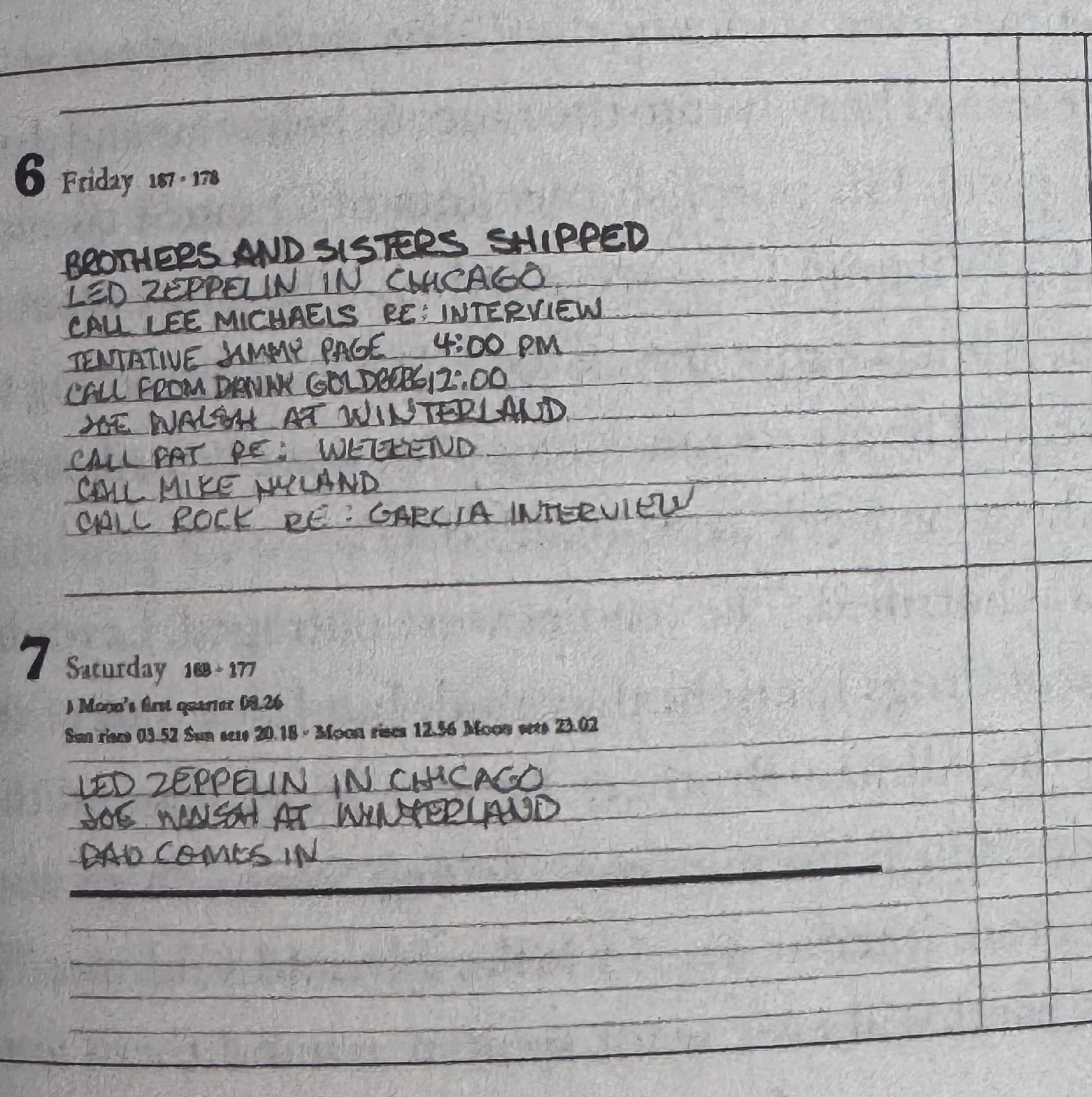
That’s a page from Cameron Crowe’s schedule book when he was 16-years-old.
But what’s most interesting is how he got to this point.
I’ll spare you his life story since you’ve probably already seen Almost Famous.
If you haven’t seen it, drop everything you’re doing and go watch it.
The movie chronicles his journey into the world of rock journalism, but there’s a part of his origin story you don’t see on screen – the moment he got his first music writing gig.
It’s a perfect example of what I wrote yesterday:
You get your dream job AFTER you start doing your dream work.
In Crowe’s memoir The Uncool, he describes tagging along with his older sister to a staff meeting at a local indie newspaper in San Diego before he had ever written a word about music.
It was 1971 and he was 14-years-old.
“The meeting was just about over. I was the only one who hadn’t spoken. It wasn’t my place. I had barely even been invited. I decided not to say what was on my mind. Better to shut up in the company of this extremely cool and purposeful gathering of fledgling revolutionaries, journalists, stoners, and hippies. I wasn’t about to shoot my mouth off and blow my promise to my sister about not embarrassing her with any unscripted little-brother behavior. No. But then again, there was that small voice inside that wouldn’t go away. It said: Do it.
‘I’d like to review the new James Taylor album,’ I said.”
That launched a debate among the staff over whether the paper should even do music reviews.
Ultimately, the editor turned to Crowe and said:
“Write about James Taylor if you want. There’s also a bunch of promo records leaning against the wall. Take a few. Write a few reviews. If we print your review, you can keep the record.”
And so began the career of one of the most legendary rock journalists of all time.
One more thing to note about Cameron Crowe:
He was supposed to be a lawyer like his grandfather.
His mom wanted him to become one and he assumed he would.
But then he spoke up in a meeting he wasn’t invited to and had the courage to pursue what he wanted – a chance to write about music.
He offered to DO the work before he was even old enough to have a job doing it.
The rest is history.
Doing what you want is how you get what you need.
RELATED:
• Put Yourself Where You Don’t Belong (Yet)
• Why Creators Change Niches, Business Models, and Content Strategies